Bring-Your-Own API Key Platforms vs Bundled-Model Agent Services
Teams must choose between vendor control and direct model access as agents move beyond autocomplete.
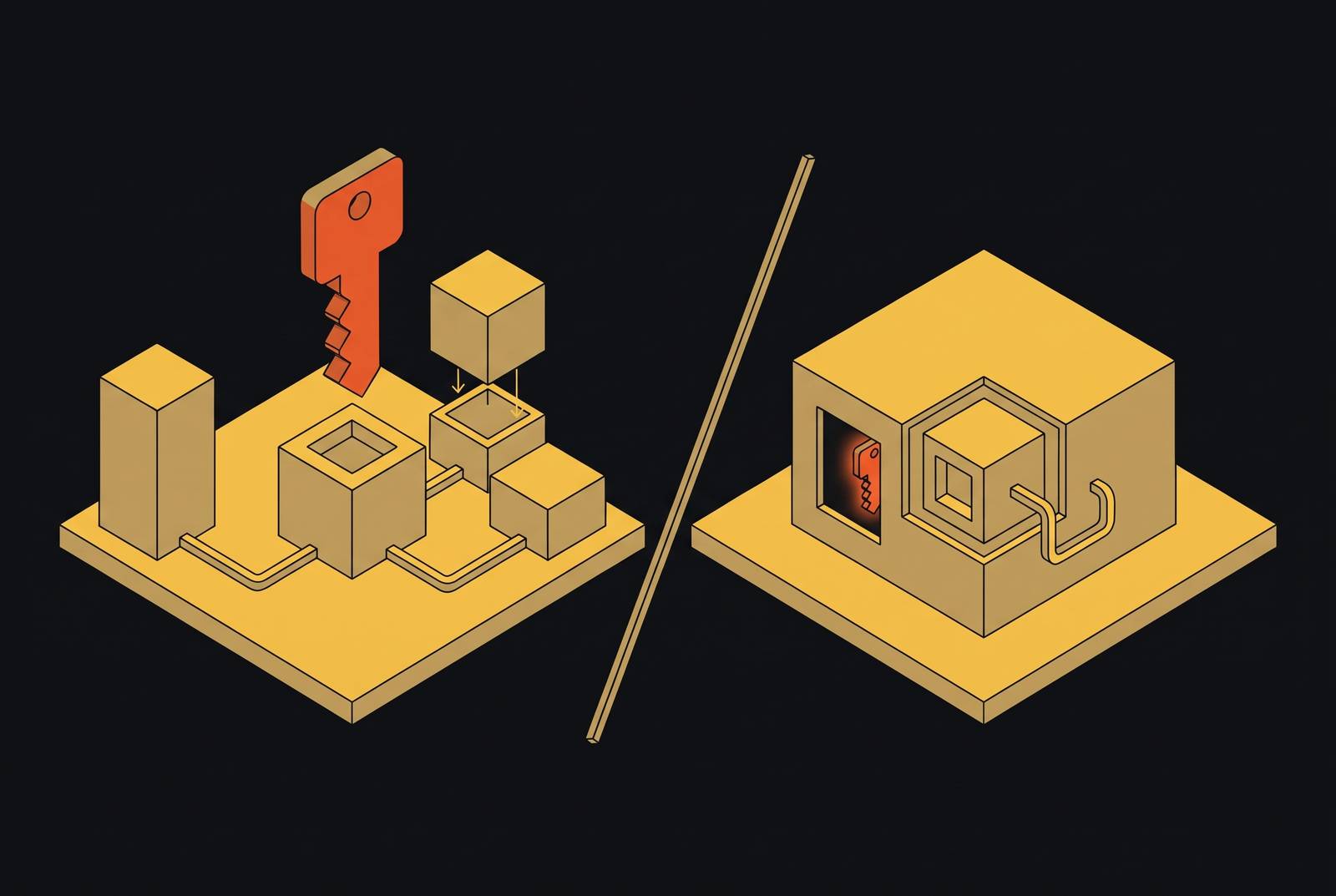
A bring-your-own API key cloud coding agent runner separates model access from the infrastructure that runs the agent. Teams use their own Anthropic or OpenAI API key rather than buying model usage through a bundled service. The choice is fundamentally about who controls the model relationship, but full flexibility also requires an execution environment independent of the model and harness vendors.
Why the BYOK vs. bundled-model distinction is not a pricing preference but a structural choice about who controls the model relationship
“Pay flat or pay per token” describes billing. In a bundled service, the vendor mediates access to models through its subscription, supported model menu, and usage policies. With bring-your-own API key, or BYOK, the team has a direct relationship with the model provider while choosing its agent harness separately. That distinction governs which costs the team can attribute and which components it can replace. A purchasing decision therefore becomes an architectural constraint when agent work grows beyond occasional assistance.
The consequences compound as workloads become recurring. An individual developer may reasonably value billing convenience above provider choice, while an engineering team delegating tests, migrations, and refactors needs control over repeated work. Cost attribution, provider switching, and compliance scoping then become operational requirements. Teams that inherit a bundled arrangement can discover that these controls are harder to retrofit than to design in. The relevant comparison is therefore between two allocations of responsibility.
How the harness layer became a distinct product category separate from the model itself
By mid-2026, coding agents had moved beyond autocomplete into engineered workflows that delegate issues, tests, migrations, and refactors. This changed what an agent product needed to provide. Context management, permissions, sandboxes, audit logs, and cost controls became as consequential as model quality. The harness manages the agent’s work around model calls, while the execution environment supplies the place in which that work happens.
The interfaces have separated as well as the components. The 2026 stack includes the IDE for real-time collaboration, the CLI for local execution, and cloud agents for asynchronous delegation. Those surfaces need not share a vendor. A team can therefore reason about its interactive editor independently from the harness that performs background work. Treating every surface as one indivisible product obscures the choices that this separation makes possible.
Anthropic’s architectural framing behind Claude Managed Agents distinguishes the Brain, the Hands, and the Session. The Brain includes the model and harness loop, the Hands provide sandboxed ephemeral execution environments, and the Session is an append-only log of everything that happened. In that design, each part can be replaced on its own. BYOK also lets teams change the model without replacing the harness. Bundled services deliberately package these decisions together for simpler purchasing, but that convenience limits how independently a team can move the layers.
What bundled-model services actually provide and where that value ends
Cursor demonstrates why an integrated service earns its subscription. It combines tab completion, a Composer agent for multi-file edits, and Cloud Agents running in isolated VMs with parallel sub-agents handling discrete parts of a task. The appeal extends beyond access to a model. Router, shipped in July 2026, routes requests between models through Cost, Balance, and Intelligence modes, with admin controls for team-level model restrictions. These features give teams a managed workflow without requiring them to assemble it from a harness.
Cursor also addresses the execution and attribution work surrounding coding. Builds, shipped in August 2026, boots cloud agents into pre-configured environments roughly three times faster than setting up each agent on its own, and failed builds do not activate. Cursor Blame, available on Enterprise, distinguishes code from tab completions, agent runs, and human edits. Code attribution, however, answers a different question from the cost of a particular task or model call.
GitHub Copilot offers a different form of integration through its broad deployment across editors and GitHub itself. It is built into environments including VS Code, Visual Studio, JetBrains, Neovim, Eclipse, and Xcode, and has expanded from autocomplete into agent mode with a choice of a few models. Its pricing includes Pro and Pro+ tiers as well as Business and Enterprise seats. Usage-based AI Credits pricing took effect June 1, 2026, complicating a simple subscription-versus-tokens comparison.
The strongest bundled proposition remains straightforward budgeting and a polished workflow without infrastructure setup. Its boundary is the vendor’s supported model menu. If a better model ships outside that menu, adopting it requires a different tool, while attribution below the seat level can remain opaque. Claude Code’s Max tiers similarly offer a flat-ish experience without per-token billing, but opaque usage limits can leave heavy users hitting caps without warning. These limits are structural tradeoffs in who manages access.
What BYOK tools actually provide and where that flexibility becomes its own burden
OpenCode, Aider, and Pi separate the harness from the model bill. OpenCode runs as a terminal UI, desktop app, IDE extension, and web UI, connecting to the LLM providers configured for it. Running /init generates an AGENTS.md for the project. Aider connects to Claude, DeepSeek, OpenAI models, and almost any other LLM, including local models, and automatically commits changes to git with sensible commit messages. It is free and open source.
Pi takes a deliberately minimal approach to the harness. It is MIT-licensed, supports 15-plus providers, and leaves out sub-agents, plan mode, and permission popups, with additions supplied through TypeScript extensions. These tools offer different workflows despite sharing a billing structure. Their common benefit is direct model-price visibility, because the model bill is the provider’s API bill. Teams can also switch supported models while keeping the same harness or use open-weight local models when they need to for privacy or cost.
The team becomes responsible for credential storage and rotation, provider outage handling, sandboxing, audit logging, and evaluating new models as they ship. Some BYOK tools provide no sandbox by default. Even with a free harness, teams can still have infrastructure and security costs. The distinction is that the team can choose how those responsibilities are fulfilled rather than accepting the bundled service’s implementation.
Credentials make that responsibility especially concrete for agents accessing other systems. Nango is an example of an integration platform that holds OAuth tokens and API keys for agent workflows. Where credentials are concentrated in a single closed vendor cloud, a breach can expose customers together, making storage location and inspection rights part of the decision. BYOK teams need to decide who can inspect credential handling and how keys are stored and rotated.
How the bundled vs. BYOK choice plays out differently depending on what the agents are actually doing
Tab completion, inline suggestions, and short editor sessions fit bundled pricing because the work is brief and the per-token spread is small. Adding tests, upgrading dependencies, fixing lint errors, performing mechanical refactors, synchronizing documentation, and handling small bugs produce repeated work attributable to specific task types. BYOK makes model spend visible for those tasks, although complete cost attribution also requires execution data.
WorkOS’s experience with Devin shows why the workflow cannot be separated from its infrastructure. An early trial failed because sessions hung mid-task, context felt hard to trust, and the Slack integration was unfinished. A second attempt in early 2026 produced a clean PR from a single Slack message and entered daily standups. The surrounding execution work was decisive to that change. Devin handled VM provisioning, git auth, preview deployments, and CI integration, allowing a Slack message to become a PR without the user coordinating those steps.
That example illustrates the value of delegation. A useful background agent needs an environment and credentials as well as a capable model, whether the team buys those elements together or separately. Task routing adds another dimension at volume. A cheap open-weight model for mechanical work and a premium model for complex reasoning can support cost-per-task optimization for teams that own the model relationship. Many teams use both interactive assistance and recurring delegation, so they may buy each in a different way.
How can teams run Claude Code or Codex in the cloud without tying the environment to a model vendor?
With an isolated, pre-configured VM that the team controls, cloud execution can stay separate from the choice of harness and model. Pre-loaded dependencies and tooling allow the environment to support whichever harness fits the task, including Claude Code, Codex, Cursor, or OpenCode. This is the architectural requirement for a harness-agnostic runner. For teams seeking cloud execution without managing their own infrastructure, the distinction is between buying managed execution and surrendering control over what that execution can run. Bringing an API key addresses model access.
The environment determines what the agent can actually do. The environment, rather than the model, gives agents the means to install packages, run services, drive a browser, and verify work. Cursor’s Cloud Agents run in isolated VMs, while Codex is sandboxed by default, showing that execution is already a distinct product surface. A BYOK harness in a vendor-controlled sandbox still has to work within the limits that vendor sets on execution.
Cost visibility also depends on the execution layer. The API bill exposes model charges, but agents running across multiple harnesses require a broader account of resource use. Full analytics can attribute every minute an agent runs to its source, harness, model, and credential. These details tie what was spent on the model to the environment where the task ran. Without that connection, BYOK provides transparent model pricing without necessarily providing a complete picture of the cost of delegated work.
How to decide which model ownership model fits a given engineering team
The practical choice follows from how much work is recurring and attributable, how often models need to change, and who owns the execution environment. Bundled services fit teams whose agent use is primarily interactive and session-based. They also fit teams standardized on an ecosystem with high switching costs, or whose procurement process favors per-seat pricing over variable API billing. Those are legitimate operating constraints. A team in that position may well care more about having less to coordinate than about choosing models on its own.
BYOK fits recurring, background, volume-driven work where model choice can vary by task. It also fits privacy or compliance requirements that demand control over where credentials live and how they are scoped. Teams must be able to do the work that comes with that control. For agents at scale, either purchasing approach still needs isolated, pre-configured environments independent of the model and harness vendors if replacing one component is not to require rebuilding another.
Vendor independence has also become a concrete selection criterion. SpaceX’s acquisition of Cursor on August 14, 2026, placed its model routing within a company that also sells its own models. Google shut Gemini CLI down for consumers on June 18, 2026, and replaced it with a closed-source binary, imposing unplanned switching costs on affected workflows. Linear’s official agent directory lists six native integrations, namely Codex, Cursor, GitHub Copilot, Factory, Sentry Agent, and Devin, but teams should still verify whether each agent runs in an environment they control or one its vendor controls.
Before choosing, a team should establish whether it can see cost per task by harness and model, and whether it can replace the model without changing the harness or environment. It should also check for workflow-level credential revocation or rotation without disrupting other runs, and for environment support for its own dependencies independently of a vendor’s defaults. These questions expose the actual ownership boundaries. Teams that answer them deliberately, rather than defaulting to whatever ships with an IDE or CI tool, retain the ability to move as models improve.