Connecting Coding Agents to Linear for Automated Issue Resolution
Teams must optimize trigger, environment, and output layers to reliably ship agent-generated fixes.
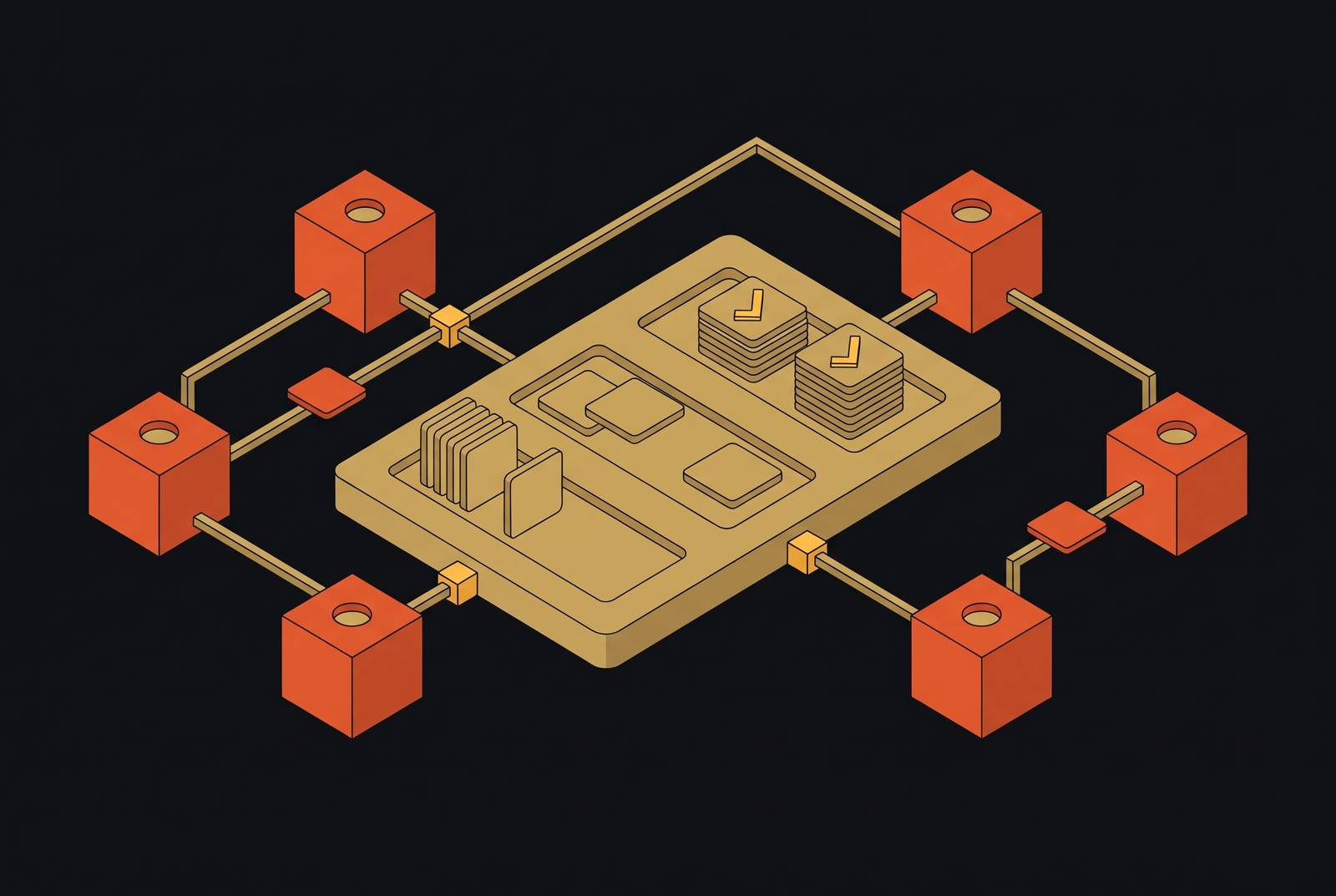
To connect coding agents to Linear for automated issue resolution, teams need to set up three layers with care: trigger, environment, and output. With Linear’s June 2026 coding sessions, teams can run Claude Code or Codex in the cloud from issues they assign, chats, comments, or Slack threads. To resolve issues reliably, teams need to do more than start an agent: they must send it suitable issues in an environment that works and get back changes that humans can review.
Why connecting Linear to a coding agent is harder than it looks
An issue assignment now delegates an entire engineering task. The agent must read the issue, explore the codebase, edit files, run tests, and return a pull request. Unlike line-level autocomplete, this work calls for the agent to make new decisions as it learns more. A successful hand-off shows only that the agent started work. It does not establish that the agent can understand the repository, reproduce the failure, or validate a fix.
This distinction makes the integration an architectural problem. The trigger layer determines which work enters the pipeline and what the agent receives. The environment layer supplies the context, dependencies, and access needed to complete that work. The output layer turns the result into something a person can review. Teams can get issue pickup working and still have runs that fail or PRs that go unreviewed because the other layers are not fully set up.
How the trigger layer works: getting Linear to hand off an issue reliably
Engineers can assign an issue directly to Linear Agent or ask it to make a change in a chat, comment, or Slack thread. The Slack path allows a team to request coding work from an existing discussion. Automated triage goes further by letting the agent investigate new issues and attempt fixes before an engineer receives them. Teams configure that path in their Triage settings.
These paths serve different levels of delegation. With manual assignment, a person can choose a task with a clear scope, while automated triage needs the team to decide ahead of time which tasks qualify. Without that definition, intake can send the agent work it cannot finish. A suitable issue has a clear scope, behavior the agent can reproduce, and a clear acceptance criterion, such as passing tests without a regression. The trigger decision therefore determines both the work admitted and the interface used.
Issue quality also governs where the agent begins searching. Know Before Fix describes how gaps in repository knowledge can lead agents toward shallow, keyword-based localization and an incorrect understanding of the failure. A vague ticket leaves that gap unresolved. The lesson for teams is to establish agent-eligible criteria before enabling automated triage, including an observable failure and a testable outcome. A Slack request needs the same discipline as an assigned Linear issue.
What the environment layer must provide for an agent to do reliable work
Once an issue reaches the agent, the execution environment becomes the next constraint. Even with a clear task, the agent needs access to private dependencies and secrets, along with tests it can run. These requirements govern execution. Linear’s coding sessions run in the cloud and draw on workspace context, including issue details, history, customer requests, discussions, and related work. That context gives the session background, but it does not replace a functioning development setup.
Linear allows coding sessions to access environment secrets during setup so they can fetch private dependencies and other environment configuration. This bridges a practical gap between a cloud sandbox and the project’s dependency graph. The environment must also support the work required for verification, including installing packages, running services, and driving a browser where needed. Functional equivalence is the relevant standard here. A patch validated under incomplete conditions can still break in CI.
Repository knowledge is a separate requirement from runtime access. The ACQUIRE framework acquires structured repository knowledge before attempting repair, including cross-module dependencies, implicit API contracts, and data-flow details. ACQUIRE demonstrates that this approach outperforms proceeding directly to a patch when the agent lacks that understanding. Knowledge-deficient attempts spend more tokens and execution steps without proportional success. Environment design must therefore provide both the means to execute the project and the context needed to reason about its behavior.
Choosing between Claude Code and Codex inside Linear's coding sessions
Linear supports both Claude Code and Codex, but the harness choice should follow the issue type. Claude Code can run multi-hour sessions and uses an autonomous MEMORY.md store to keep preferences, corrections, and what it learns from sessions. User-authored project conventions belong more naturally in CLAUDE.md. The /goal command, shipped in May 2026, lets the agent work on long tasks without a human stepping in. These features make Claude Code a good fit for issues with a larger scope that need work over a longer stretch.
Codex places greater emphasis on short tasks and parallel throughput. It inspects repository state to learn code style, while teams maintain explicit behavioral guidance in AGENTS.md. That file gives instructions but cannot enforce them. Codex is consequently a better fit for high-volume, bounded work such as lint fixes, dependency upgrades, and test additions, where parallelism is more useful than one long session. The distinction is between workload shapes.
Process efficiency is another useful selection criterion. TRACEPROBE’s illustrative trajectory analysis shows Claude Code with Opus 4.6 reaching a targeted fix in a small number of steps without failed actions. The research’s broader finding is that resolved runs differ in how quickly they reach relevant code and how much failed work they incur. Teams should route issues accordingly and preserve the ability to switch harnesses as models improve, rather than accumulating configuration debt through a fixed choice.
How the output layer determines whether a PR gets merged or ignored
A completed coding session is not yet a shipped fix. Linear returns a diff for review when a change is ready, and teams can share preview links, bring teammates into the discussion, and request further iterations in the same thread. However, they do not by themselves make an oversized change easy to assess. The output layer must account for the reviewer’s time and confidence.
A reviewer must understand unfamiliar code, assess whether it addresses the reported failure, and decide whether the verification supports merging it. Larger diffs make that work harder to complete quickly. If the team leaves generated PRs unmerged, it pays for both the agent’s work and the time spent on review without shipping the result. Accounting for this review burden is a workflow design requirement.
Teams should keep the scope of issues small at intake, require passing tests, and set a diff size threshold so that the amount of output alone does not count as progress. Run analytics can then help teams see which issue types lead to clean changes and which make the agent keep going back to recover from problems. TRACEPROBE shows that searches, edits, reasoning, and validation can show signs of failure that stay hidden in a final pass/fail result. Those signals make it possible to improve the assignment and environment instead of treating every difficult PR as an isolated review problem.
What Linear resolves internally and what that benchmark implies for your team
Linear reports resolving roughly 30% of incoming bug reports, mostly on the first pass. The result provides a production benchmark. Linear controls the codebase, test suite, workspace context, and workflow in which its agent operates. It has tuned those conditions deliberately over time. A team starting from scratch must establish comparable access and verification before using the reported outcome to judge its own pipeline.
Dead feature flags and failing background tasks are examples of work for which the agent has been tuned. Linear’s engineers say that broader issue types still need a narrower ask and the right context. That places substantial preparation at triage, before a reviewer sees a patch. First-pass success depends partly on making the assignment resolvable in the first place.
The benchmark becomes more informative as the team learns which issue types resolve cleanly, which produce oversized diffs, and which require human rework. Instrumentation supplies that feedback across all three layers. Without it, a low resolution rate does not reveal whether intake, environment setup, or output design needs attention. Teams can iterate toward the benchmark only if they can distinguish those causes.
The review capacity ceiling that agent volume will eventually hit
A human still needs to review every agent-opened PR in this workflow. Agent throughput can grow without a corresponding increase in the time engineers have to assess changes. That mismatch can negate gains from faster implementation. It is also important to separate agent-opened PRs from AI-assisted human authorship. The broader review bottleneck at teams operating at volume is driven by the surge in AI-assisted human output, while agent-opened PRs remain a very small share of all PRs.
Small, well-scoped issues produce changes that are easier to inspect, while agents that run tests and validate their work reduce the reviewer’s burden. Analytics can identify assignments that consistently produce messy output so teams can narrow or stop delegating them. TRACEPROBE detects anti-patterns such as search loops and verification skips in run traces, giving teams evidence for changes to scoping or harness configuration. Treating review capacity as a design constraint allows delegation to grow around what the team can actually merge.
How to configure the three layers end-to-end for a team starting out
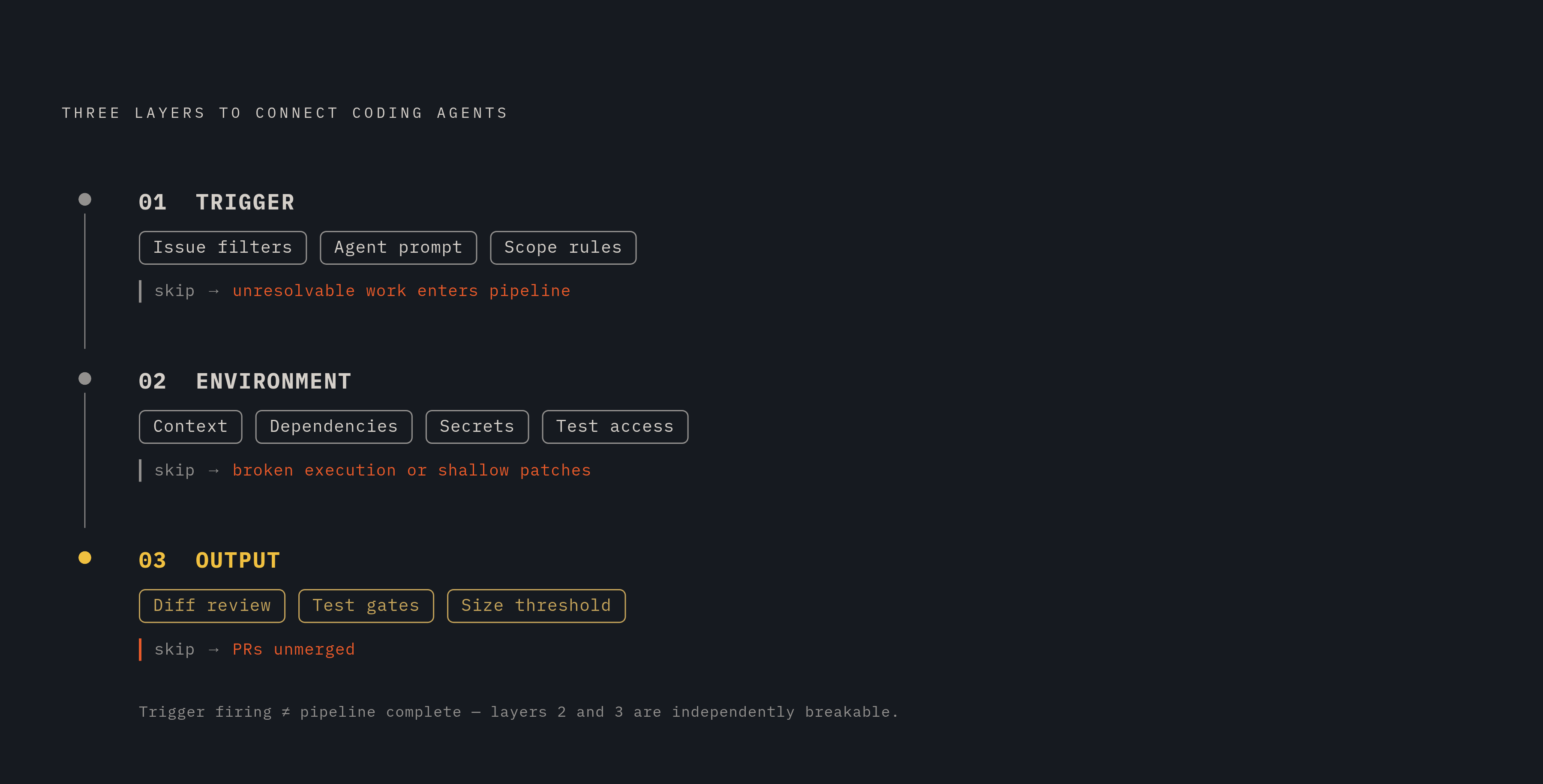
For a team building this integration, the practical sequence is trigger, environment, then output. Start with manual assignment to Linear Agent before enabling automated triage, so engineers can see how different issue types behave before volume increases. Define eligibility through bounded scope, a reproducible test case or observable failure, and a clear acceptance criterion. Enable the Slack-thread path for hand-offs from existing discussions. Coding sessions require a GitHub connection with code access, and workspace admins enable them in Settings and manage access, usage, and credits through the usage dashboard.
Next, make the environment capable of completing those assignments. Configure secrets during coding session setup so the agent can fetch private dependencies, and establish that it can run the project’s required tests. Pre-load concise conventions and constraints in CLAUDE.md for Claude Code or AGENTS.md for Codex. Keep that guidance focused on likely mistakes. For Claude Code, plan proactive context compaction rather than waiting for the context window to fill, while Codex workloads should favor short parallel runs over long sequential work.
Then define what qualifies as review-ready output. Require tests to pass before the agent opens a PR, with “ready” meaning that the work has progressed from “code written” to “CI green”. Use a diff size threshold to decide which issues qualify, and split any that are likely to go over it before assigning them. Use Linear’s review thread, preview links, teammate mentions, and same-thread iteration rather than scattering the discussion across GitHub comments.
Instrument every run from the start of this process. Track which issue types resolve cleanly, which require rework, and which leave changes sitting unmerged, with attribution to the harness, model, and credential used for each run. Those records support routing decisions and expose configuration weaknesses before automated intake magnifies them. Increase delegation against that evidence.