Slack Linear and GitHub as First-Class Agent Trigger Surfaces Compared
GitHub, Slack, and Linear each provide different context, audience, and governance for agent work.
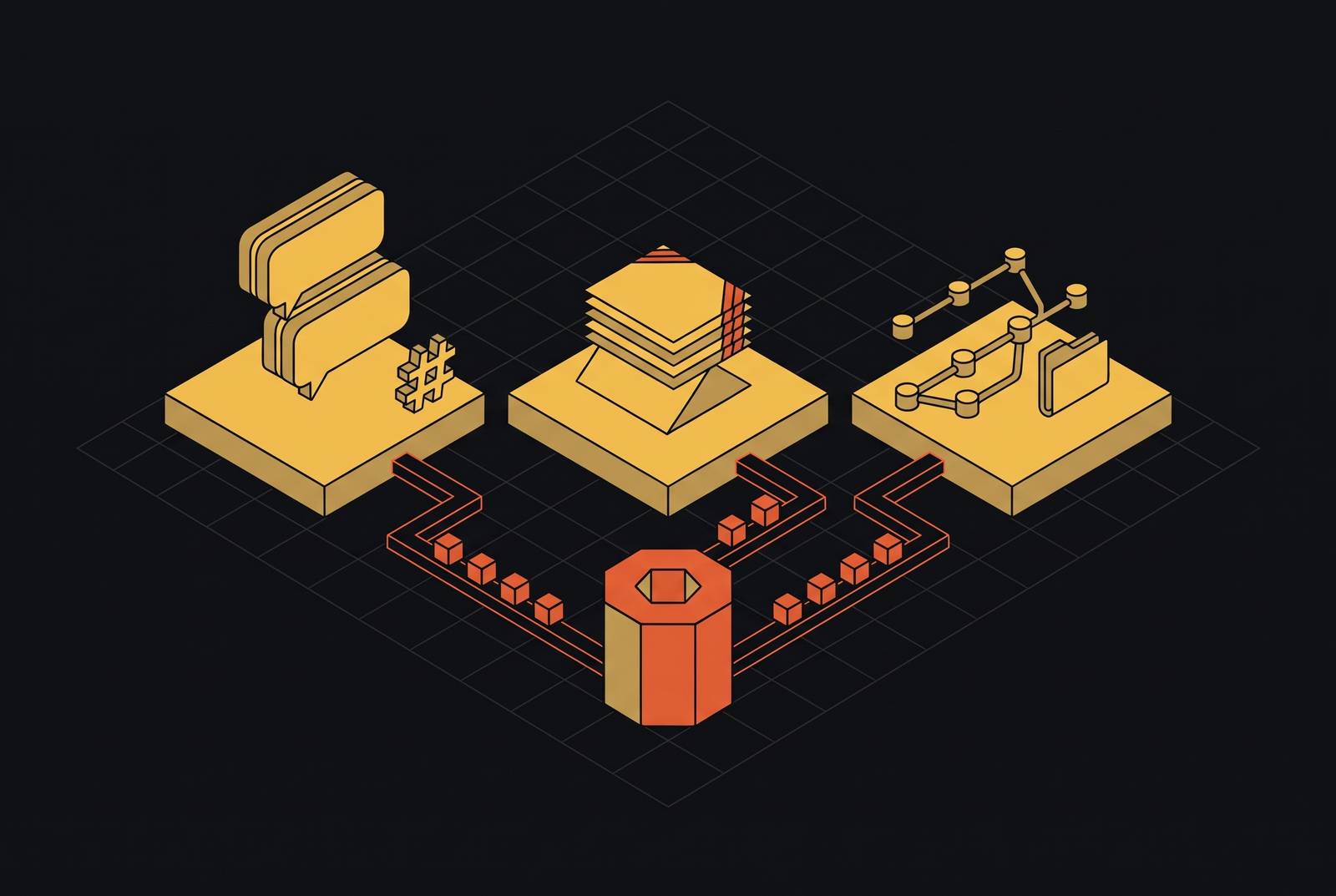
Slack, Linear, and GitHub are distinct trigger surfaces for cloud coding agents. GitHub fits work scoped to code, Slack fits requests that come out of a conversation, and Linear fits work based on product planning. For engineering teams choosing cloud coding agents, the deciding criteria are what context reaches the agent, who can authorize and observe its work, and whether the resulting record supports review.
Why trigger-surface selection is a structural decision, not a convenience one
Starting an agent from whichever tool is already open looks like a small workflow choice. It establishes boundaries before execution begins. A repository event makes a code artifact the starting point, while a channel request brings a conversation and its participants into scope. An assigned issue instead anchors the task in planned work. These differences affect whether the agent starts with the reasoning behind a request or must retrieve it elsewhere.
The same choice determines where people encounter the work and how they account for it afterward. Even when a pull request is technically complete, a product manager may still be unable to see why an agent chose an approach. Conversely, a visible channel discussion does not automatically supply the repository state needed to implement that approach. The trigger is therefore the first governance decision. Its context, audience, and record must fit the task before model or harness selection can resolve the remaining execution questions.
What GitHub event triggers give an agent and what they leave out
GitHub gives the agent the most structured place to start with code. A task launched from a pull request or issue is grounded in the repository, with its relevant diff, commit history, request text, and existing test and CI setup. The event further bounds the assignment, whether a PR opens, a comment appears, a check fails, or an issue receives a label. The agent starts from a defined change or condition rather than an open-ended chat instruction. That structure reduces how much technical context must be reconstructed.
This makes GitHub a natural fit for automated PR review, CI failure triage, and fix-and-rerun cycles after test regressions. Description generation when a draft PR becomes ready follows the same pattern, because the code artifact already defines the work. Review also has an established home. An agent-authored PR must pass the repository’s branch protection rules, required reviewers, and CI checks rather than bypassing them through a separate approval path. Before turning on triggers, teams should also decide whether agents may change CI/CD workflow configuration.
The agent cannot see the Slack discussion that led to an approach, or a changed product requirement missing from the issue description, unless someone brings it over. The participation boundary is equally consequential. Designers, product managers, and support leads have no natural way to join in when an agent’s work happens inside a repository. The gap follows from a surface built for engineers reading code, rather than from any deliberate decision to exclude other contributors.
What Slack does that GitHub cannot: visibility and inherited conversational context
Slack gives those contributors a way to join the conversation about the work. A thread-triggered agent inherits the discussion that produced the request, including stakeholder preferences, organizational reasoning, and decisions already made. Its strength is the reasoning surrounding the task. That reasoning can be central when an incident or exploratory request has not yet become a well-scoped code artifact.
Slack Code lets people work together this way through its multiplayer design. Dedicated tabs inside the channel expose code diffs, a live preview of the running output, the agent’s plan, and the conversation. An engineer, product manager, and designer can inspect the same task during execution and redirect it before a finished PR arrives. This trigger-surface model builds in context scoped to the task, work the team can see as it runs, and ways for people to redirect it, without a separate review step.
The record also follows the conversation’s shape. Archiving closes the channel and produces a time-stamped, searchable account of the request, the agent’s work, and the review without a separate logging system. The trade-off is that a chat message does not arrive with repository state already attached. The agent must fetch that state, so conversational richness does not remove the need for technical enrichment. AppspringTech’s integration guide recommends keeping repository notifications in the same Slack channels so that the agent and participants have the technical context behind the alert or request.
What Linear adds when issue context is the right starting point
Linear starts from a different body of context. An assigned issue can give the agent its full history, related customer requests, past discussions, and links to related work. This is richer product and planning context than a raw Slack message, while remaining accessible to a broader product development audience than a repository event. The issue connects the requested change to its rationale. That makes this surface a good fit for bug fixes that have customer history and backlog work that has linked requirements.
Linear’s June 11, 2026 changelog describes coding sessions that use workspace context and says that Linear Agent can write code using Claude Code and Codex. Sessions can begin through issue assignment or a request in a chat, comment, or Slack thread. They run in the cloud without requiring a local development environment. A request that starts in Slack can thus reach a session that also has issue details, discussions, customer requests, and related work. The entry point and the context source need not be identical.
Linear uses an automated first pass internally, allowing the agent to investigate and attempt a fix before a new issue reaches an engineer. It reports resolving roughly 30% of incoming bug reports through this workflow, mostly on the first pass. The ticket, session, and PR from that work stay linked. Reviewers can follow why a change exists rather than examining only its implementation, while workspace admins enable sessions and manage access, usage, and credits.
The agent still needs a repository connection to retrieve the diff, CI state, and branch history. GitHub, Slack, and Linear can all route to the same underlying execution environment, even though they supply different starting material and expose the work to different people.
How the three surfaces compare on context, audience, and audit trail
For starting context, GitHub is strongest where the work is already expressed in code. Its diff, history, CI state, and branch rules give the agent a structured technical frame, but little of the surrounding organizational conversation. Slack reverses that balance through the thread, its stakeholders, and their decisions. Linear supplies a third frame through issue history, customer requests, related work, and project links. Both Slack and Linear require repository enrichment rather than providing code-structural context automatically.
For audience, the distinction is where participation happens naturally. GitHub serves engineers working in the repository, whereas Slack reaches the cross-functional participants in the channel or workspace. Linear serves the product development team under workspace access controls. A repository-only review may suit a test regression, while an incident response may need the broader group already discussing it in Slack.
For the audit trail, each surface preserves a different chain of evidence. GitHub keeps the PR, its linked issue, CI results, and review comments in the repository. Slack Code preserves the exchange through its archived channel, while Linear links the ticket, agent session, and resulting PR and gives admins a usage dashboard. The records answer overlapping but distinct questions. GitHub emphasizes the proposed change and its checks, Slack the exchange and intervention, and Linear the path from product or customer need to implementation.
These distinctions make task fit more useful than an overall ranking. PR review and CI triage already have code artifacts that suit GitHub, while exploratory requests benefit from Slack’s conversational starting point. Linear’s record built around the issue fits planned fixes that have customer history. Those differences stay the same even if the underlying model changes. The trigger layer determines which evidence and participants are present before the model begins its work.
Governance properties that must hold regardless of which surface fires the agent
Agents should be able to investigate and propose changes, but not merge them. Draft pull requests, required human review, and protected main remain the rule regardless of whether the request came from a PR comment, a Slack channel, or a Linear issue. A more accessible trigger must not imply broader authority. Otherwise, the same task would have different safeguards just because a developer started it somewhere else.
AppspringTech’s integration security guide recommends a separate identity for each integration, with credentials independent of a human account’s token. Fine-grained PATs or GitHub App installations should be scoped to specific repositories with the narrowest permissions. The scope allows contents read and pull requests read/write, but gives no admin or secrets-write permissions. Identity must remain distinct from conversational participation. Someone’s ability to observe or redirect a task is not a reason to give the integration broader repository privileges.
Both a PR-triggered task and a channel-triggered task should run in isolated environments, because a shared environment allows one agent’s actions to affect another’s. Such interference weakens the connection between a task’s visible record and its actual output. Each run should also be attributable to its trigger surface, harness, model, and credentials. Without that attribution, the surface-level record cannot be connected to execution cost or results.
Review capacity is the operational constraint that remains after these controls are established. Adding trigger surfaces gives more people and events a way to request work, but does not itself add human review capacity. Larger AI-generated PRs increase that burden. Teams therefore need to plan how much work they can review as carefully as how much they can trigger.
Deciding which surface to wire up first, and how to expand from there
Where the work already lives and who needs to see it determine which surface to wire up first. A team whose tasks are already code artifacts and whose audience is engineering-only should start with GitHub, because the technical context and review infrastructure are already present. A team handling cross-functional requests or incidents should start with Slack, where the conversation travels with the request. A team that manages engineering work through Linear should start there when issue history and planning context set out what needs to be done. Technical sophistication is not the deciding criterion.
AppspringTech’s guide recommends beginning with one review pattern and one alert pattern before adding more surfaces. This gives the team a bounded way to establish review discipline rather than multiplying entry points before accountability is clear. Expansion should deepen context. A Slack request turned into a Linear issue before execution can combine conversational reasoning with planning history. The changelog explicitly supports starting coding sessions from Slack threads, so these surfaces can work together.
The execution environment should preserve that flexibility. It should accept triggers from all three surfaces and route work to Claude Code, Codex, Cursor, or Opencode as appropriate, rather than making one surface’s harness support the permanent routing constraint. The final test is whether a reviewer, using only the record left behind, can understand why the agent was invoked, what it did, and who authorized it. If any answer is missing, the audit trail needs work before the team adds another surface.