Devin Alternatives for Engineering Teams Running Cloud Agents
Production fit depends on environment quality, harness flexibility, and delegation surface.
Teams that picked Devin because it scored well on a benchmark or impressed everyone in a demo are now running into a different problem entirely: those criteria say nothing about whether the agent fits the workflow it has to operate inside once it's doing production work. A cloud agent ships code inside a team's existing systems based on environment fit, integration model, and harness flexibility, and a leaderboard score measures none of those three.
The underlying shift is organizational, not technical. Engineering teams have moved from AI-assisted coding, where an engineer writes most of the code with suggestions from a model, to delegation at scale, where engineers orchestrate agent sessions and review the output. That shift changes who the decision belongs to. Choosing a cloud agent is no longer a matter of individual developer preference; it's now an infrastructure and workflow decision that affects how a team routes work, reviews changes, and manages risk. The 2026 cloud agent roadmap frames this directly: the operative question in 2026 isn't which model scores highest on a benchmark, it's which agent workflow fits the team's codebase, budget, and risk boundary.
Teams that outgrow Devin tend to hit one of three friction points. The first is environment constraints that prevent real verification: an agent can propose a change but can't confirm it works. The second is harness lock-in, where the workflow is built around one coding agent and can't easily absorb a better model when one ships. The third is a delegation surface that doesn't connect to where the team already works, so engineers have to check a separate dashboard instead of seeing agent output where they already track issues and pull requests.
The three axes that differentiate cloud coding agents for production team use
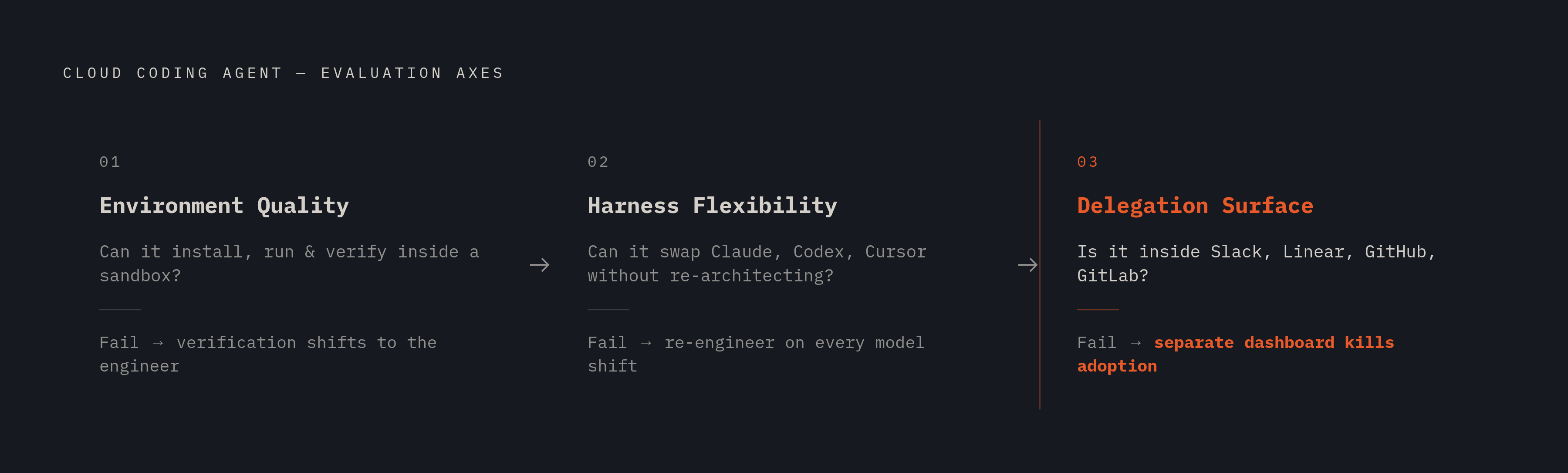
Most comparisons of cloud coding agents default to task-completion demos, here's a ticket, here's the agent resolving it, here's the pull request, and that format hides the three axes that actually determine whether an agent fits a production team: environment quality, harness flexibility, and delegation surface. A team that evaluates agents only on whether they can complete a task is missing the three variables that decide whether that completion translates into shipped, trustworthy work week over week.
Environment quality asks a specific question: can the agent actually verify its own work? Cloud agents earn their value on bounded, testable, reviewable tasks, adding tests, upgrading dependencies, fixing lint errors, running mechanical refactors, keeping documentation in sync. An agent that can't install packages, run a service, or drive a browser inside its own environment can't confirm the change it just proposed, and that gap pushes verification back onto the engineer, which erases most of the time savings delegation was supposed to deliver. The isolation technology used for that verification step, whether microVM or container-based, carries real consequences. MicroVM-isolated environments, built on technology like Firecracker or Kata Containers, give each workload its own kernel, so a bad run stays contained to that run. Container-based environments instead have agents sharing the host kernel, so the isolation boundary between one agent's mistake and everything else on that host is narrower. Cloud platforms like Replicas run each agent task in its own isolated Linux VM, pre-loaded with a team's dependencies and tooling, so an agent can install packages, run services, and verify its own work without touching other workloads or shared infrastructure.
Harness flexibility asks a simple question: can a team switch models without rebuilding the entire delegation workflow around the new one? Locking a workflow into a single coding agent means that when a stronger model ships, the team either forgoes the improvement or spends real engineering time re-platforming to use it. The pace of change in 2026 makes that risk concrete: an October 2026 industry snapshot recorded Claude Code's adoption growing sharply while Copilot's declined, and Codex's use rising through the middle of the year. A workflow wired to one harness has to be re-engineered every time the ranking shifts. Platforms that support Claude Code, Codex, Cursor, and Opencode interchangeably, Replicas among them, let a team send a given task to whichever agent suits it best without re-architecting anything when the underlying model landscape moves again.
Delegation surface asks if the agent shows up where the team already triggers and tracks work, or if it demands a new tool be adopted alongside the old ones. When engineers have to open a proprietary dashboard or a separate chat window, the agent adds friction at the exact moment a team is trying to remove it. Agents that surface inside Slack, Linear, GitHub, or GitLab issues get used, because that's where the decisions about what to build next already happen. Microsoft's July 2026 study on agent rollout found that first use spread mainly through peer networks and manager usage, not through demographics or formal training programs, so if a delegation surface is already visible to the rest of the team, adoption compounds faster than a tool that sits off to the side. A team can turn to these three axes together when it needs to evaluate any cloud agent, even ones not covered here.
What the current field of Devin alternatives covers
The agents competing for Devin's former role in a workflow aren't interchangeable. They sit at different points on a spectrum running from editor-connected pairing to fully asynchronous, fire-and-forget delegation, and the right shortlist for a team depends on where its work actually originates.
GitHub Copilot's coding agent is the closest mainstream analog for teams already living inside GitHub. An engineer assigns it a GitHub Issue, and it goes to work in a GitHub Actions environment, exploring the repository, changing code, running tests, and opening a pull request, all without leaving the native GitHub flow. GitHub's own documentation draws a clear line between two modes: agent mode inside the IDE is synchronous pairing, while the coding agent is asynchronous delegation, a different category of work. The environment comes with real constraints. Internet access is limited to a trusted destination list that administrators configure, and CI/CD workflows require human approval before running, though GitHub's changelog notes that repository administrators can now skip that approval step so workflows run immediately. Positioned against the rest of the field, Copilot's coding agent sits between an editor assistant and a fully autonomous cloud engineer: more autonomous than Cursor running in editor mode, more hands-on than a service that disappears with a task and reappears with a finished pull request.
OpenAI's Codex cloud service runs async, parallel task execution inside OpenAI-hosted environments. The hosted service and the local Codex CLI are separate execution surfaces, and a team evaluating Codex needs to decide which one fits its delegation workflow, since cloud tasks, GitHub code review, and Slack integration are features tied to a hosted subscription plan while API-key access does not include them. Pricing runs on a token-based model starting at the Plus tier for $20 a month, and that allowance is shared with the local CLI, so usage through one surface draws down the same plan limit as usage through the other.
Cursor Cloud Agents work for teams that want local editor work and remote cloud work to live in the same surface. Agents run in isolated VMs, can use a browser, run software, and return review artifacts for an engineer to check, and teammates can share a workspace to prompt an agent together. The feature is available on Pro and above, including Teams and Enterprise plans, and supports cloud workspaces connected to GitHub, GitLab, Bitbucket Cloud, and Azure DevOps repositories. Pricing starts at the Pro tier, with network access and usage costs varying by workload. Cursor Cloud Agents make the most sense when connecting a local editor session to a remote background task is part of the actual workflow, not for teams looking for pure async delegation.
Factory's Droids are built specifically for large, legacy codebases and enterprise CI/CD integration. The platform is agent-native, organized around Droids that handle coding, review, testing, research, and reliability work. It supports automated code changes and checks through droid exec inside CI/CD pipelines, and it can run parallel tasks across separate Git worktrees. Factory positions itself explicitly for large enterprises that carry complex codebases, some of them decades old. Pricing starts at a Pro tier.
Replicas takes a harness-agnostic approach: rather than standardizing a team on one coding agent, it runs Claude Code, Codex, Cursor, or Opencode, each in its own isolated, fully configured Linux VM pre-loaded with the team's dependencies and tooling. Agents operating inside that sandbox can install packages, run services, and drive a browser to verify their own work, and every run is attributable back to its source, its harness, its model, and the credential that triggered it. A published backlog experiment documents the workflow on a real maintenance task, REP-503, a batch of React lint fixes, where the agent started the application inside its sandbox and checked it before opening the pull request; the same experiment logs failed tasks and the follow-up work they generated alongside the successful runs. For a team that wants task delegation, a choice of agent, and verification inside a running environment, without having to commit to one agent's ecosystem, that combination is the core of the pitch.
Integration Surface and Adoption
Adoption of a cloud coding agent inside a team is driven by where the agent appears in a team's existing tools, not by what it can technically do. An agent capable of resolving the hardest tickets in a backlog still goes unused if engineers have to leave their existing tools to reach it, and a less capable agent that lives inside the channel where the team already works gets picked up faster.
Slack is one of the clearest examples. Slack Code gives engineering teams dedicated channels where developers, agents, and colleagues plan, build, and review software inside the same workspace they already use for everything else. The agent becomes reachable at the exact point where a conversation about a bug or a feature is already happening, which lowers the activation cost of delegating that work to it.
Linear illustrates the same principle with more structure attached. Linear Agents are third-party coding tools, Cursor, GitHub Copilot, Devin among a growing list of integrations, installed into a workspace and assigned issues directly, the same way a human teammate would be assigned a ticket. Delegating to Linear's own agent feature, rather than to one of those third-party tools, triggers a session through Claude Code or Codex, drafts a pull request, and drops the diff into the issue for review, a capability available on Basic, Business, and Enterprise plans that draws from a shared AI credit pool. The feature only works as intended when it's configured: skipping Agent Guidance setup is the most common reason agent output feels random, and that's a function of teams skipping the context-setting step, not a flaw in the integration itself.
GitHub and GitLab carry the issue-to-pull-request path that forms the backbone of asynchronous delegation across the field. GitHub Copilot's coding agent makes that shift through GitHub Issues: assign an issue, and the agent explores the repository, runs tests, and opens a pull request inside the same Actions environment. Factory's Droid follows the same logic through droid exec inside CI/CD pipelines and parallel Git worktree sessions, designed to slot into a pipeline a team already runs.
Linear's own account of how its team works before it built its agent feature is the clearest illustration of what mature integration looks like in practice. Coding agents were already part of how the team built software across Slack, Linear, and the codebase itself, well before any dedicated agent product existed. A coding agent reviews every pull request, leaning on Codex for that task though Claude Code is supported as well, and a human engineer still makes the final approval call. Once a pull request merges, the GitHub integration marks the related Linear issue "Done" automatically, closing the loop entirely inside tools the team was already using before any agent entered the picture. A customer email becomes a shipped feature. A Slack thread becomes a pull request. A PM filing an issue becomes a fix that ships. The delegation surface in that account is the workflow the team already had, not a new one layered on top of it.
The environment the agent runs in and production gains
Even a team that gets the integration surface right can lose the benefit of delegation if the environment the agent runs in won't let it verify its own work. An agent limited to writing code, with no ability to run the application, confirm a test passes, or check a browser interaction, produces a diff that an engineer still has to verify from scratch, which moves the bottleneck from writing code to reviewing it. An agent that can install packages, run services, and drive a browser inside its own sandbox produces evidence alongside the change it's proposing, and that evidence is what actually shortens the review cycle.
The isolation tier underneath the agent's sandbox sets the ceiling on how much verification work it can safely do. MicroVM isolation, the model behind technologies like Firecracker and Kata Containers, gives each workload its own kernel, which is the strongest isolation available: a run inside one MicroVM can't affect another run or the host machine underneath it. Container-based isolation, where agents share a host kernel, works for a wide range of tasks, but the boundary between workloads is thinner, so it opens potential escape vectors for more privileged operations. Most agent sandboxes also lock down internet access, staging environment access, and real database access for security reasons, so the agent can only verify so much before it hands a change back for review.
Environment design decides whether a team's delegation gains reach production or get absorbed back into longer code review cycles. If a workflow routes an agent's output through an environment that can install dependencies, run the application, and check a browser interaction, an engineer gets something closer to a finished, checked change to review. A workflow that can't do any of that gives the engineer a plausible-looking diff and nothing else, recreating the same verification burden delegation was meant to remove.